Healthcare Payer Analytics Solutions: Complete Guide for Cost, Use Cases & ROI
Table Of Content
Published Date :
27 Mar 2026
Healthcare payers are under continuous pressure to control costs, improve care quality, and ensure regulatory compliance. Traditional data systems are no longer sufficient to manage complex claims, member populations, and risk models. Organizations now require advanced analytics capabilities that transform raw data into actionable insights.
Healthcare payer analytics solutions enable payers to streamline operations, optimize decision-making, and improve financial outcomes. These solutions integrate data across claims, providers, members, and external systems to deliver a unified view of performance and risk.
Why Analytics is Critical for Modern Payers
Payers operate in a highly dynamic environment with increasing demand for transparency and efficiency. Analytics plays a central role in addressing these challenges by enabling the following:
- Real-time claims analysis and cost control
- Risk stratification and predictive modeling
- Fraud, waste, and abuse detection
- Population health management
- Value-based care optimization
Without a structured analytics framework, organizations face fragmented data, delayed insights, and inefficient resource allocation.
Strategic Value Delivered
Healthcare payer analytics solutions provide measurable business impact across key operational areas:
- Cost optimization: Reduce unnecessary claims payouts and administrative overhead.
- Improved member outcomes: Enable proactive care interventions through predictive insights.
- Operational efficiency: Automate reporting and streamline workflows.
- Regulatory compliance: Ensure accurate reporting and audit readiness.
- Scalable decision-making: Support enterprise-wide analytics across multiple data sources.
Organizations that implement advanced payer analytics report improvements in cost efficiency ranging from 15% to 30% and faster decision cycles by up to 40%.
According to McKinsey, advanced healthcare analytics can reduce administrative costs by up to 25% while improving care outcomes through data-driven interventions.
Deloitte reports that AI-enabled payer analytics improves fraud detection accuracy by over 30% and accelerates claims processing efficiency.
Core Components of Healthcare Payer Analytics Solutions
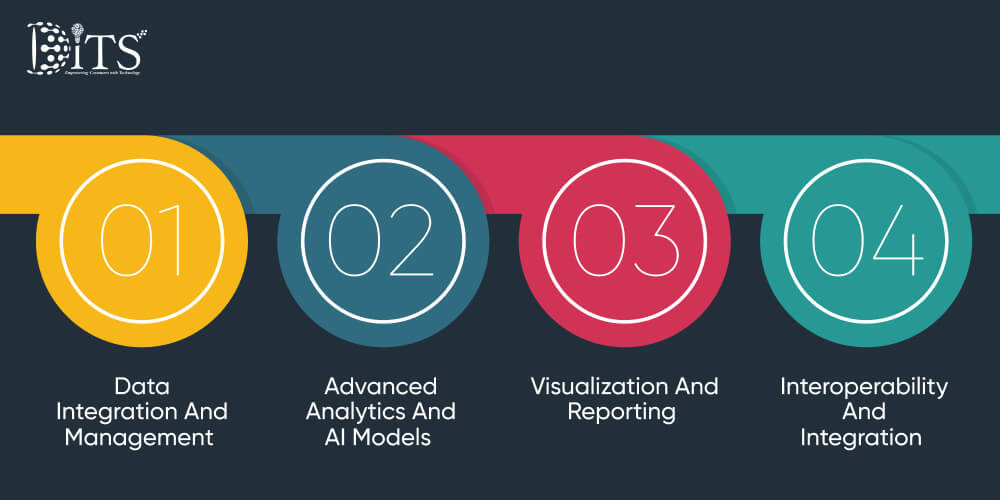
A robust healthcare payer analytics platform is built on multiple integrated components that work together to deliver end-to-end intelligence. These components ensure scalability, performance, and interoperability across systems.
Data Integration and Management
Data integration forms the foundation of any analytics solution. Payers must consolidate structured and unstructured data from multiple sources, including
- Claims data
- Electronic health records
- Member demographics
- Provider networks
- External datasets such as social determinants of health
Key capabilities include:
- Real-time data ingestion
- Data normalization and standardization
- Master data management
- Secure data governance frameworks
This layer ensures data accuracy and consistency, which is critical for reliable analytics outcomes.
Advanced Analytics and AI Models
Modern payer analytics platforms leverage artificial intelligence and machine learning to generate predictive and prescriptive insights. Organizations leverage specialized AI software development services to design scalable models that support risk prediction, fraud detection, and cost optimization.
Key capabilities include:
- Predictive risk scoring for members
- Cost forecasting and utilization modeling
- Fraud detection using anomaly detection algorithms
- Clinical pathway optimization
AI-driven analytics enable organizations to move from reactive reporting to proactive decision-making.
Visualization and Reporting
Decision-makers require intuitive dashboards and reporting tools to interpret complex data. Visualization layers provide the following:
- Real-time dashboards for claims and cost tracking
- Customizable reporting for different stakeholders
- Drill-down capabilities for granular insights
- KPI tracking aligned with business objectives
This component ensures that insights are accessible and actionable across departments.
Expert Perspective:
Healthcare organizations are shifting from retrospective reporting to predictive intelligence. Leading payers prioritize unified data ecosystems and AI-led decision frameworks to enable real-time risk mitigation and cost control.
Interoperability and Integration
Healthcare ecosystems involve multiple systems and stakeholders. Analytics solutions must integrate seamlessly with:
- Core payer systems
- Provider platforms
- Third-party applications
- Regulatory reporting systems
Standards-based integration ensures data flow without disruption and supports scalable deployment.
Are you ready to optimize payer analytics outcomes?
Identify gaps in your analytics strategy and unlock measurable improvements in cost efficiency, fraud detection, and operational performance.
Reference Architecture for Healthcare Payer Analytics
Data Sources
- Claims systems
- EHR and clinical data
- Member and provider data
- External datasets
Data Layer
- Data ingestion pipelines
- Data warehouse or data lake
- Data governance and security
Analytics Layer
- Machine learning models
- Predictive analytics engines
- Risk scoring systems
Application Layer
- Dashboards and reporting tools
- Workflow automation systems
- API integrations
Outcome Layer
- Cost optimization
- Fraud prevention
- Care improvement
Comparison of Traditional vs Advanced Payer Analytics
| Capability | Traditional Systems | Advanced Analytics Platforms |
| Data Processing | Batch-based | Real-time processing |
| Insights | Descriptive | Predictive and prescriptive |
| Fraud Detection | Rule-based | AI-driven anomaly detection |
| Scalability | Limited | Cloud-native scalability |
| Integration | Siloed systems | Unified data ecosystem |
| Decision Speed | Delayed | Near real-time |
Key Use Cases of Healthcare Payer Analytics
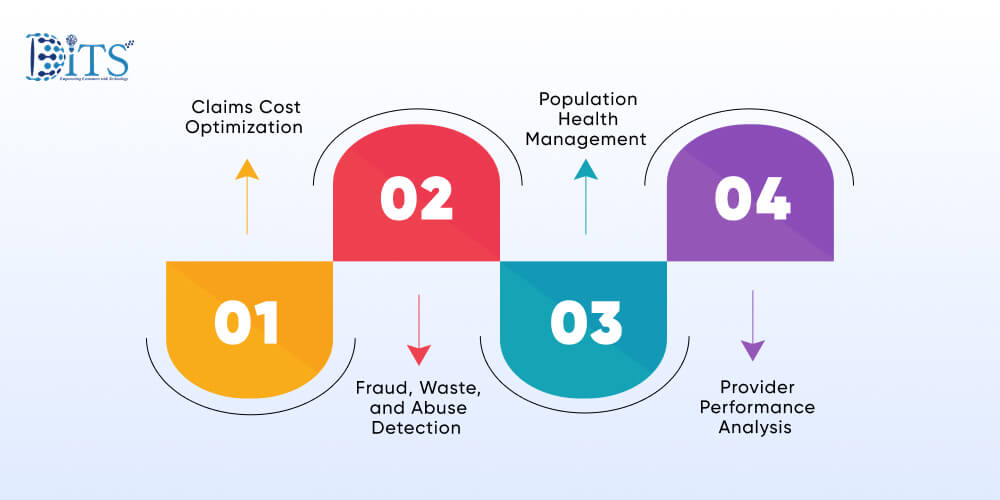
Healthcare payer analytics solutions are applied across multiple business functions to drive efficiency and improve outcomes. These use cases demonstrate how organizations leverage analytics to address real-world challenges.
Claims Cost Optimization
Claims management is one of the most critical cost drivers for payers.
Analytics solutions enable:
- Identification of high-cost claim patterns
- Detection of billing anomalies
- Automation of claims adjudication processes
This is further enhanced through business workflow automation services, which streamline claims processing, reduce manual intervention, and improve turnaround time across high-volume payer operations.
Impact:
- Reduction in claims leakage by up to 20%
- Faster claims processing cycles
- Improved financial accuracy
Read our Portfolio: Cloud-Based Healthcare Claims Automation Platform
Fraud, Waste, and Abuse Detection
Fraud detection remains a major priority for healthcare payers. Advanced analytics platforms use machine learning models to identify suspicious activities.
Capabilities include:
- Pattern recognition across large datasets
- Real-time fraud alerts
- Risk scoring for providers and claims
Impact:
- Reduction in fraudulent claims payouts
- Enhanced compliance with regulatory requirements
- Improved audit readiness
Population Health Management
Analytics enables payers to manage member populations more effectively by identifying high-risk individuals and optimizing care strategies. This approach aligns with the growing adoption of AI in healthcare, where predictive intelligence drives proactive care delivery and improved patient outcomes.
Key capabilities:
- Risk stratification based on health conditions
- Predictive modeling for disease progression
- Identification of care gaps
Impact:
- Improved health outcomes
- Reduced hospital readmissions
- Lower overall healthcare costs
Read our Portfolio: SaaS RPM & IoT Platform for Public-Health Programs
Provider Performance Analysis
Payers need to evaluate provider performance to ensure quality care and cost efficiency.
Analytics solutions provide:
- Performance benchmarking across providers
- Cost versus outcome analysis
- Identification of high-performing networks
Impact:
- Better provider network optimization
- Improved contract negotiations
- Enhanced value-based care initiatives
Cost Structure of Healthcare Payer Analytics Solutions
Understanding the cost dynamics of Healthcare Payer Analytics Solutions is critical for effective planning and ROI evaluation. Costs vary based on platform complexity, data volume, integration requirements, and level of AI adoption. These platforms are typically developed as part of enterprise-scale healthcare software development initiatives. This ensures seamless integration with core payer systems, regulatory compliance, and long-term scalability across analytics workflows.
Key Cost Components
Healthcare payer analytics implementations typically include the following cost elements:
Platform and Licensing Costs
- Subscription-based analytics platforms or custom-built solutions
- Pricing varies based on number of users, data volume, and feature access
- Cloud-based platforms offer flexible pricing models
Data Integration and Engineering
- Integration with claims systems, EHRs, and third-party data sources
- Data cleansing, normalization, and transformation
- API development and interoperability setup
This phase often accounts for 25% to 35% of the total implementation cost due to complexity.
AI and Advanced Analytics Development
- Machine learning model development and training
- Predictive analytics and risk modeling
- Continuous model optimization
Organizations investing in AI-driven analytics may see higher upfront costs but significantly better long-term value.
Infrastructure and Cloud Costs
- Cloud storage and computing resources
- Data processing pipelines
- Security and compliance infrastructure
Cloud-native solutions reduce capital expenditure while enabling scalability.
Maintenance and Support
- Ongoing system monitoring and updates
- Model retraining and performance tuning
- Technical support and enhancements
Maintenance typically represents 15% to 20% of annual platform costs.
Estimated Cost Range
Based on enterprise scale and requirements:
- Mid-sized implementation: $150,000 to $400,000 annually
- Enterprise-scale deployment: $500,000 to $1.5M+ annually
- Custom AI-driven solutions: Higher initial investment with scalable ROI
Organizations must align investment with business objectives and expected outcomes rather than focusing solely on upfront costs.
ROI of Healthcare Payer Analytics Solutions
Healthcare payer analytics delivers measurable returns by improving efficiency, reducing costs, and enabling better decision-making. ROI is realized across multiple operational and financial dimensions.
Key ROI Drivers
Claims Cost Reduction
- Identify unnecessary or duplicate claims
- Optimize claims adjudication processes
- Reduce leakage and overpayments
Typical impact:
- 10% to 25% reduction in claims costs
McKinsey estimates that optimized claims analytics can unlock $150B to $300B in annual savings across the US healthcare system.
Deloitte highlights that predictive analytics adoption reduces unnecessary utilization by up to 20%.
Operational Efficiency Gains
- Automate manual reporting and workflows
- Reduce administrative burden
- Improve turnaround times
Typical impact:
- 30% to 50% improvement in operational efficiency
Fraud Detection and Prevention
- Detect fraudulent activities early
- Reduce financial losses from abuse and misuse
Typical impact:
- 20% to 40% reduction in fraud-related losses
Improved Member Outcomes
- Enable proactive interventions through predictive analytics
- Reduce hospital readmissions and high-cost treatments
Typical impact:
- 15% to 25% reduction in avoidable care costs
Long-Term Strategic Value
Beyond immediate financial returns, payer analytics solutions enable:
- Scalable data-driven decision-making
- Faster response to regulatory changes
- Stronger positioning for value-based care models
- Improved provider collaboration
Organizations that implement advanced analytics capabilities achieve faster time-to-insight and sustain long-term competitive advantages.
ROI Summary Snapshot
- 10% to 25% reduction in claims costs
- 30% to 50% improvement in operational efficiency
- 20% to 40% reduction in fraud losses
- 15% to 25% reduction in avoidable care costs
- ROI realization within 12 to 18 months
Are you leveraging data for real-time decision-making?
Understand how to transform fragmented data into actionable insights that improve claims processing and operational efficiency.
Implementation Challenges and Best Practices
While the benefits are significant, implementing healthcare payer analytics solutions involves several challenges. Addressing these proactively ensures successful deployment and adoption.
Common Challenges
Data Fragmentation
Payers often operate across multiple disconnected systems, leading to inconsistent and incomplete data.
Impact:
- Poor data quality
- Delayed insights
- Limited analytics accuracy
Integration Complexity
Integrating legacy systems with modern analytics platforms requires significant technical effort. Many organizations address this challenge through legacy modernization services, enabling seamless data flow and improved system interoperability.
Impact:
- Increased implementation timelines
- Higher integration costs
Regulatory Compliance
Healthcare data is highly sensitive and subject to strict regulations.
Impact:
- Need for robust security and governance frameworks
- Increased compliance overhead
Skill Gaps
Advanced analytics requires expertise in data science, AI, and healthcare domain knowledge.
Impact:
- Dependency on external partners
- Slower adoption
Best Practices for Successful Implementation
Establish a Strong Data Foundation
- Implement data governance frameworks
- Ensure data standardization and quality
- Build scalable data pipelines
Adopt a Phased Implementation Approach
- Start with high-impact use cases
- Scale gradually across departments
- Validate outcomes at each stage
Leverage AI and Automation
- Integrate predictive analytics early
- Automate repetitive processes
- Continuously optimize models
Ensure Interoperability
- Use standards-based integration
- Enable seamless data exchange across systems
Partner with Technology Experts
- Work with experienced healthcare analytics providers
- Accelerate implementation timelines
- Reduce risk and ensure scalability
Strategic Implementation Outcome
Organizations that follow a structured implementation approach typically achieve:
- Faster deployment cycles by up to 30%
- Higher adoption rates across business units
- Improved ROI realization within 12 to 18 months
Industry Insight:
Enterprises that align analytics initiatives with business KPIs during early implementation phases achieve faster ROI realization and higher adoption across operational teams.
Implementation Experience Across Healthcare Payers
End-to-end software development services play a critical role in building, integrating, and scaling healthcare payer analytics platforms across enterprise environments.
Organizations implementing healthcare payer analytics solutions typically follow a structured transformation roadmap:
- Data consolidation across 5 to 10+ systems including claims, EHR, and provider data
- Deployment of AI models for fraud detection and risk scoring within 3 to 6 months
- Integration with core payer platforms using API-driven architecture
- Gradual rollout across claims, care management, and finance functions
Observed Outcomes:
- 20% reduction in manual claims review efforts
- 25% faster reporting cycles
- 15% improvement in care management efficiency
Looking for expert guidance on payer analytics strategy?
Connect with specialists to define your roadmap, modernize systems, and implement scalable analytics solutions.
Why Choose DITS for Healthcare Payer Analytics Solutions
DITS enables healthcare organizations to design, develop, and scale advanced payer analytics platforms that align with enterprise-grade operational and financial objectives.
We focus on building integrated analytics ecosystems that connect data, intelligence, and workflows across the payer value chain. This ensures that organizations can move beyond fragmented reporting and establish a unified, data-driven operating model.
Deep Healthcare and Payer Domain Expertise
- Extensive experience working with claims data, provider networks, and member populations
- Strong understanding of payer-specific challenges including cost containment, fraud detection, and regulatory compliance
- Ability to design analytics solutions aligned with value-based care models
End-to-End Engineering and AI Capabilities
- Custom healthcare software development tailored to payer ecosystems
- Advanced AI model development for predictive analytics, risk scoring, and fraud detection
- Integration of analytics platforms with core payer systems and third-party applications
Scalable Data and Analytics Architecture
- Cloud-native platforms designed for high-volume healthcare data processing
- Real-time data pipelines and analytics engines
- Secure and compliant infrastructure aligned with healthcare regulations
Integration and Modernization Expertise
- Seamless integration with legacy systems and modern platforms
- API-driven architecture for interoperability across systems
- Support for large-scale data migration and system transformation initiatives
Outcome-Focused Delivery Model
- Focus on measurable business outcomes including cost reduction and efficiency gains
- Accelerated implementation timelines with phased deployment strategies
- Continuous optimization of analytics models and system performance
Proven Impact Across Implementations
- Up to 25% reduction in claims processing costs
- 30% improvement in operational efficiency through automation
- Faster decision-making enabled by real-time analytics
DITS combines domain expertise, advanced engineering capabilities, and a results-driven approach to help healthcare payers unlock the full value of analytics investments.
FAQs
What are healthcare payer analytics solutions?
Healthcare payer analytics solutions are platforms that analyze claims, members, and provider data to improve cost control, risk management, and decision-making.
How do healthcare payer analytics solutions reduce costs?
They reduce costs by identifying inefficient claims, preventing fraud, and optimizing care utilization through data-driven insights.
What are payer analytics platforms used for?
Payer analytics platforms are used for claims analysis, fraud detection, risk scoring, population health management, and provider performance tracking.
How is AI used in healthcare payer analytics?
AI is used to predict risks, detect anomalies, automate claims processing, and generate real-time insights for proactive decision-making.
What is the ROI of healthcare payer analytics solutions?
Healthcare payer analytics solutions deliver ROI through reduced claims costs, improved efficiency, and faster decision-making, typically within 12 to 18 months.
What challenges do payers face in implementing analytics solutions?
Payers face challenges such as data fragmentation, legacy system integration, compliance requirements, and limited analytics expertise.
How do healthcare software development services support payer analytics?
They enable the development, integration, and scaling of analytics platforms aligned with healthcare systems and regulatory requirements.
Why are payer analytics important for value-based care?
Payer analytics supports value-based care by enabling data-driven decisions that improve outcomes while reducing unnecessary healthcare spending.

Nidhi Thakur
With more than 19 years of experience - I represent a team of professionals that specializes in the healthcare and business and workflow automation domains. The team consists of experienced full-stack developers supported by senior system analysts who have developed multiple bespoke applications for Healthcare, Business Automation, Retail, IOT, Ed-tech domains for startups and Enterprise Level clients.
Recent Posts
Understand CRM implementation cost breakdown in 2026 with key cost components, pricing insights, and strategies to optimize investment and improve business efficiency.
Guide to building energy management systems for commercial buildings using IoT, analytics, and automation to improve efficiency, reduce costs, and enable intelligent operational control real-time.

Cut energy costs, boost efficiency, and track usage in real time with an energy management system for industries.